


Purpose of the competition
~After the 1st Tokyo International Fencing Competition~
The Future Opened by Fencing
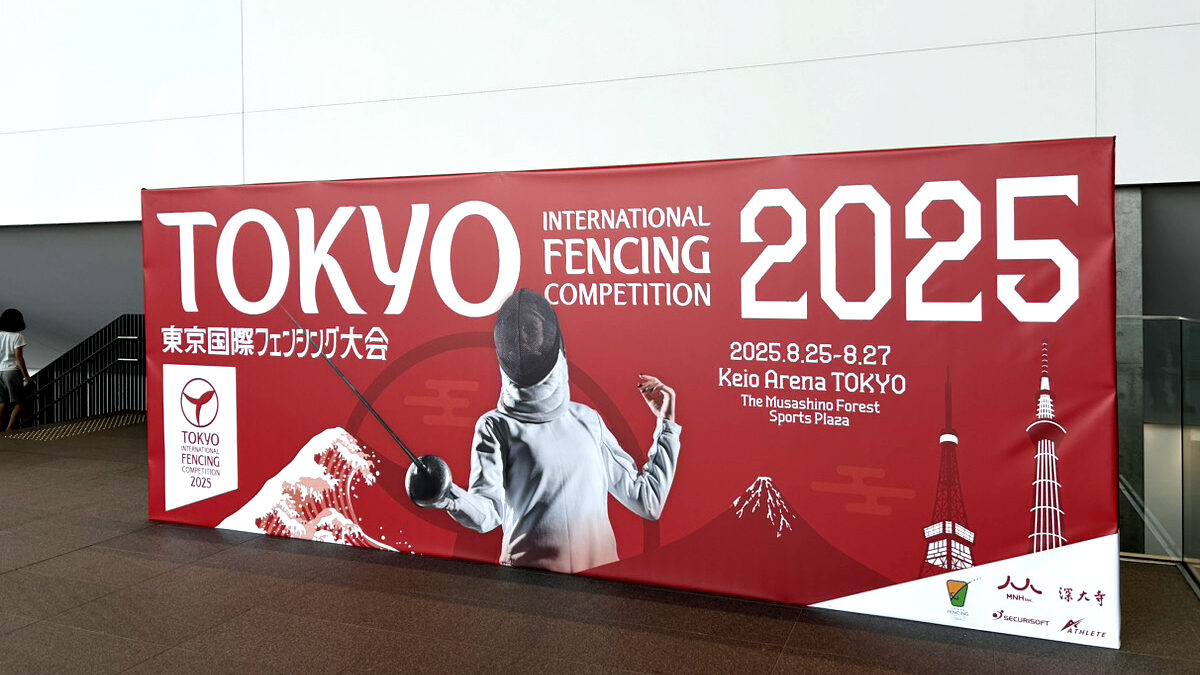
The Chofu City Fencing Association and MNH Fencing Club held the “1st Tokyo International Fencing Competition” over three days from August 25 to 27, 2025, at Keio Arena TOKYO (Musashino Forest Sport Plaza).
Approximately 500 athletes from Japan and abroad delivered passionate performances throughout the competition.
However, our goal in hosting this event was not merely to “attract many participants.”
Here, we share the future we aspire to create and the challenges ahead.
Part.1
Realizing a co-creative society through competitions for all generations
Sports Bring People Together
In today’s world, the importance of co-creation is emphasized in many contexts.
For years, our society has been driven by competition—by the idea of “becoming better than others.”
But this approach is no longer sufficient to address the complex challenges we now face. Instead, people of diverse backgrounds must work together, confront issues collaboratively, and create new value.
This kind of co-creative society is needed now more than ever.
Still, even if the importance of co-creation is explained verbally, many people may feel unsure about “where to begin.”
From a different perspective, we believe that what a community truly needs is a shared topic.
In the past, TV programs such as The Best Ten or Hachiji da yo! Zen’in Shūgō! offered widely shared entertainment across generations.
However, in the modern age, people’s interests have diversified, and common topics have dramatically decreased.
Trends differ not only between adults and children but even among students within the same elementary school.
Furthermore, the internet and social media now allow us to easily connect with people who share our specific interests. One might say that life can be lived entirely within highly segmented communities, without interacting with anyone outside them.
In such circumstances, we believe the role of sports becomes incredibly significant.
Think, for example, of the Olympics:
Children and the elderly alike can become excited about the same events.
Even when people do not share a common language, they can laugh together and feel the same emotions.
The sight of a single athlete continuing to challenge themselves can inspire millions around the world.
Sports, in this sense, function as a timeless universal language that connects people.
Realizing a Co-Creative Society Through Fencing
Many sports organizations focus primarily on strengthening athletes—on producing winners.
This is, of course, important. But we believe that the value of sports extends far beyond competition.
As mentioned earlier, sports have the power to instantly unite diverse individuals.
This aligns deeply with the concept of co-creation—a social value that is increasingly essential today.
With this in mind, we have long explored ways to create a space where co-creation can be realized through sports. Specifically, we aimed to create an environment where people of all genders, ages, and physical abilities can engage in fencing together.
This vision took shape in the form of the Tokyo International Fencing Competition.
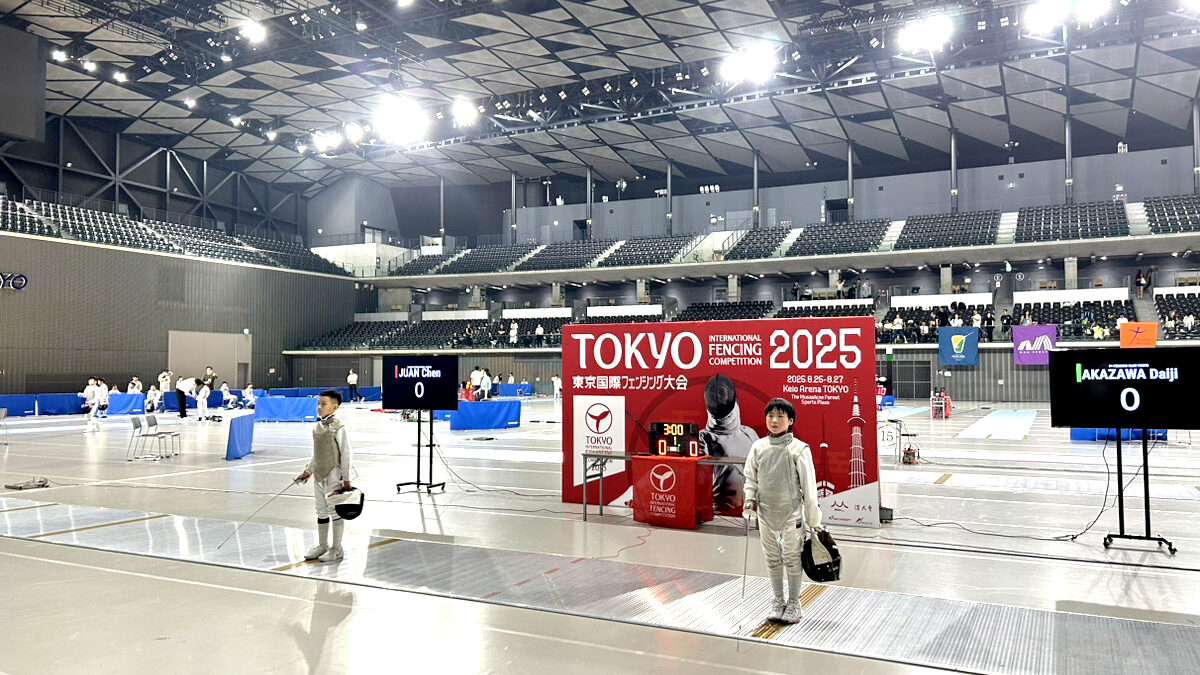
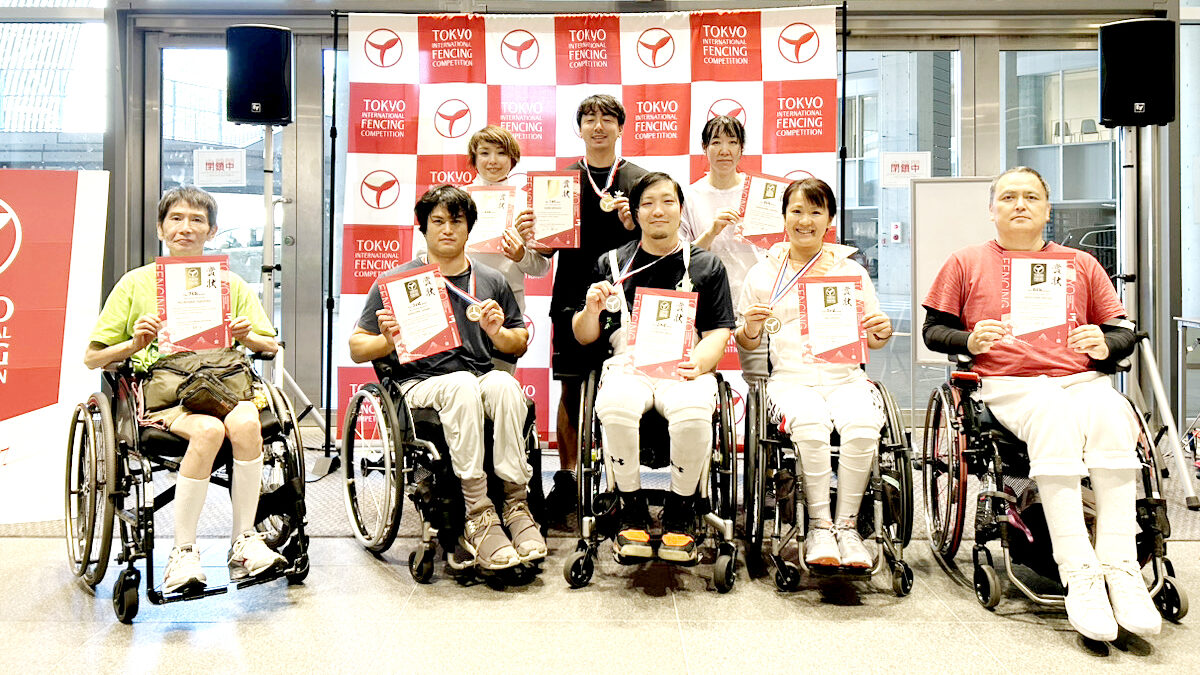
At this competition, children, veterans, and athletes with disabilities competed and enjoyed fencing within the same venue and schedule (*).
Challenges remain—such as attracting more international para-fencers—but we believe that we have taken our first meaningful step toward our own interpretation of co-creation.
This year, the categories were broadly divided into juniors and veterans, but in the future, we hope to develop the competitioninto a truly all-generations event.
(*) Competition categories:
Under-8, Under-10, and Under-12; veterans in their 50s, 60s, and 70s; and para-fencers aged 15 and older.
Part.2
A place where you can experience a world-class experience
Challenges Standing Before Hosting an International Competition
One of our strongest motivations for organizing this competition was the desire to let Japanese fencers experience the world.
Since Yuki Ota’s remarkable performance at the 2008 Beijing Olympics, fencing has gradually gained recognition in Japan.
The surge of medals at the 2024 Paris Olympics accelerated this trend dramatically, boosting the sport’s popularity.
More children have begun learning fencing, and the number of people who enjoy the sport continues to grow.
Because it can be started at any age, fencing is also gaining attention as a lifelong activity.
Yet, alongside this growth, several challenges have surfaced.
One of the most significant is the lack of opportunities to be exposed to the international level.
In fencing, the leading nations—France, Italy, and others—are concentrated in Europe.
For Japanese athletes to compete on the world stage, overseas travel is essentially unavoidable.
The major obstacle, however, is the cost of international travel.
Even Olympic-level athletes—aside from a handful of top competitors—must personally cover their overseas travel expenses, and this financial burden represents a formidable barrier.
Naturally, when amateur fencers in Japan think, “I want to gain experience against overseas athletes,” “I want to participate in an international event,”they must consider the cost of traveling abroad, causing many to hesitate.
Experiencing the World While Staying in Japan
We wanted to fulfill the hopes of these Japanese fencers.
Our conclusion was to create opportunities for overseas athletes to come to Japan.
Rather than sending individual Japanese athletes abroad, inviting a large number of international fencers here brings greater benefits.
More people can be exposed to world-class competition and atmosphere.
Thus, we intentionally labeled the event as an “International” competition and took on the challenge of hosting an international fencing competition in Japan.
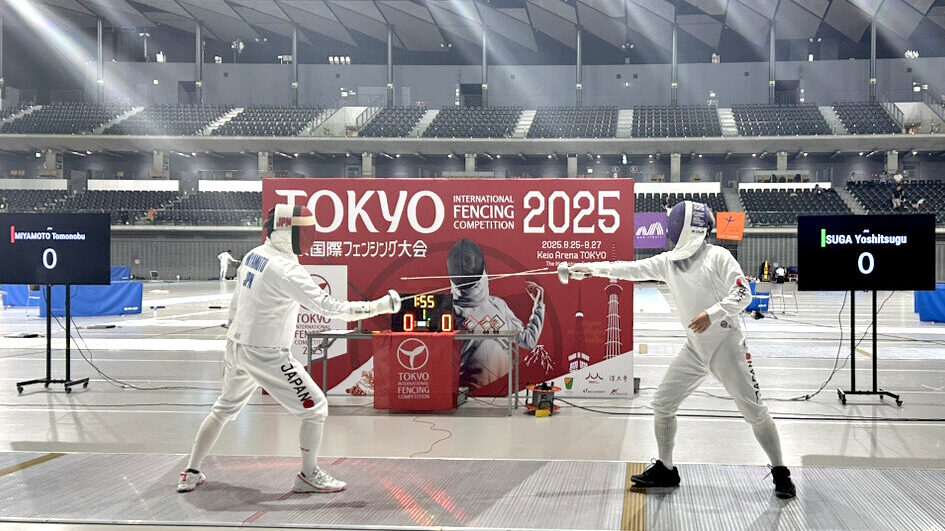
As a result, athletes from more than ten countries—including Taiwan, South Korea, Hong Kong, the Philippines, Singapore, Thailand, Indonesia, the United Kingdom, Germany, the United States, and Canada—joined us, totaling roughly 250 overseas participants.
In the venue, English announcements echoed, and many Japanese children appeared nervous as they watched foreign athletes move through the space.
Some young fencers stared intently at international competitors, noticing differences in physique and style.
Seeing these scenes reaffirmed the significance of holding an international competition in Japan.
It was clear that the participants were experiencing sensations and discoveries that domestic competitions simply cannot provide.
For them, participating in this event is not only an opportunity to test their skills but also a step toward preparing for future challenges on the global stage.
Above all, we believe that these accumulated experiences will become invaluable assets throughout their lives.
Part.3
A competition that serves as a stronghold for fencers
Winning Is Not the Only Goal
We feel that a “win-at-all-costs” mentality is still deeply rooted in Japanese sports culture.
In other words, victory over one’s opponent is treated as the absolute goal, and anything other than winning is seen as having no value.
Of course, winning has great significance.
However, in reality, only one person can take first place in a competition, and all the other athletes must inevitably experience “defeat.”
Not everyone is aiming to become a professional or an Olympian, either.
If we focus solely on a win-at-all-costs approach, children who are not yet strong or who struggle to win may find it hard to stay motivated, and some may gradually drift away from the sport.
It is sad to think that, even though they started with genuine interest, they might quit saying,
“It’s too painful not to win. I don’t want to do this anymore.”
We are concerned that this mindset of “victory above all” may be one reason why many people who continued fencing throughout their school years end up leaving the sport afterward.
That is precisely why we believe that the purpose of engaging in sports is not only to win.
Simply by taking part in a match, athletes gain invaluable experiences:
Facing a wide variety of opponents.
The will to confront difficulties.
The belief in one’s own effort.
Learning how to cope with pressure.
Encouragement from teammates.
Gratitude toward coaches and family—
The lessons to be learned are immeasurable.
In other words: What did you gain by committing yourself to this sport?
What remains with you for life?
We want to cherish that value above all.
A Place That Becomes a Spiritual Home for Fencers
With all of this in mind, we hope that this competition will become a spiritual home for fencers.
Of course, matches are at the heart of the event, but we also want it to be a place where fencers can deepen their connections with one another, not only through competition but through交流 as well.
More concretely, we hope to organize activities such as social gatherings for participating athletes and welcome parties for international fencers.
If fencers who have continued in the sport gather here once a year, they will gradually see more and more familiar faces.
They may have the chance to reunite with overseas opponents they once faced.
Seeing their fellow fencers doing well, they might naturally say:
“Are you still enjoying fencing?”
“Let’s meet again at the Tokyo International next year!”
We hope that conversations like these will arise spontaneously.
Continuing fencing is simply fun.
Through fencing, you gain more friends, and your world expands.
We want this competition to be a place where the true value of sport can be expressed to the fullest.
Revitalizing the Tama Area Through Sports
At the same time, through this competition, we hope eventually to create value from the perspective of tourism as well.
In recent years, the number of international visitors to Japan—especially Tokyo—has grown,
but popular destinations are heavily concentrated in central areas such as Shibuya, Ginza, Shinjuku, Asakusa, and Akihabara.
Places like Mitaka, Kichijoji, Hachioji, and Mt. Takao do attract some visitors,
but many foreign tourists still pay little attention to the wider Tama region.
Against this backdrop, we decided to try organizing pre-competition training camps as part of this event.
More international fencers joined than we had expected, and we saw families sightseeing in the area between training sessions.
If we can continue to hold competitions like this in the Tama area,
we hope it will become a new reason for overseas visitors to come and discover this region.
In fact, we would like to plan family-friendly sightseeing tours in the Tama area that align with the competition schedule in the future.
By doing so, we believe we can add sports as a new purpose to the usual trio of “sightseeing, shopping, and food” that many international tourists seek.
For example, the Honolulu Marathon in Hawaii generates tourism demand during the off-season, with the marathon itself as the main reason to visit.
Similarly, for people who are considering a trip to Japan, a clear purpose such as participating in or attending an international competition could be a powerful motivation.
In other words, we believe that hosting this competition can contribute to the revitalization of the Tama region.
In this way, we hope to continue exploring what we can achieve through fencing, making full use of the power and value of sport.
For future editions of the Tokyo International Fencing Competition,
if you see opportunities for collaboration, we would be delighted to hear your ideas.
We sincerely hope to meet more partners with whom we can share and discuss the future we envision.